


The man who sold my landlords their brownstone stood out front of it twice in the last month. “I used to live here,” he said, both times. The second time, he didn’t remember me, and I didn’t acknowledge that we’d met. He looked lost in deeper memories.
He was an old man, very short. He stood to the shoulder of his daughter, who had box burgundy hair, who stood to my shoulder. But the second time he told me, “It was from ‘75 to ‘95,” I was sitting, so they wouldn’t have known.
Both times, he asked me if I owned the building, which was flattering, given that it must be worth 5 million, or maybe it was just a generous assumption from someone hoping for commonality. I said, “No, we rent one floor,” both times. But the second time, I added, “But we’re actually moving next week.”
I didn’t know we were moving when I first met him.
“Why is that?” they said.
“The landlords want their daughter to have the apartment.”
“Oh,” they said.
I said, “We’ve been lucky to be here for five years,” then my face got red, as it had every time I discussed the move, from trying to hold in my grief.
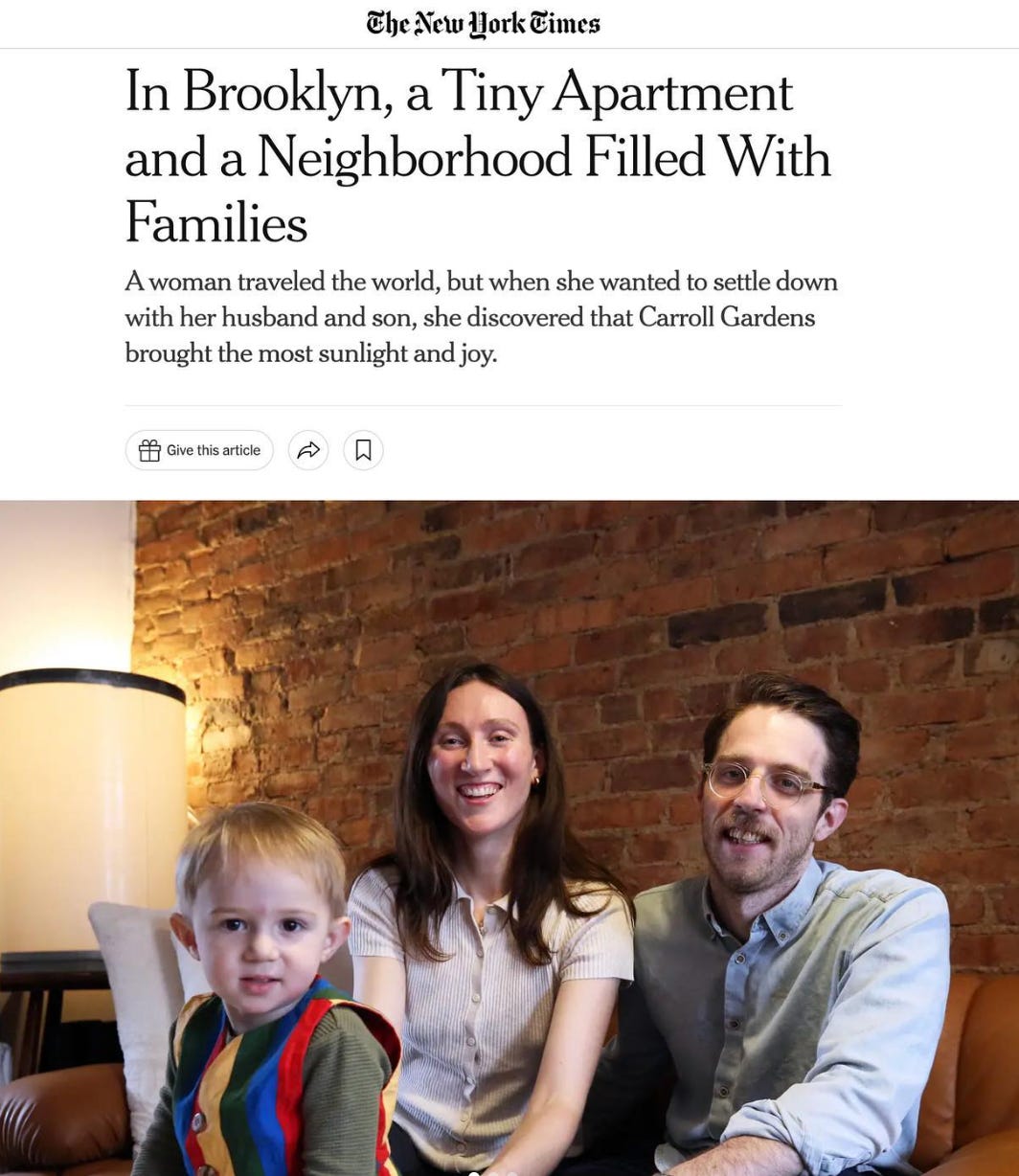
The daughter who could’ve been my mom smiled sympathetically.
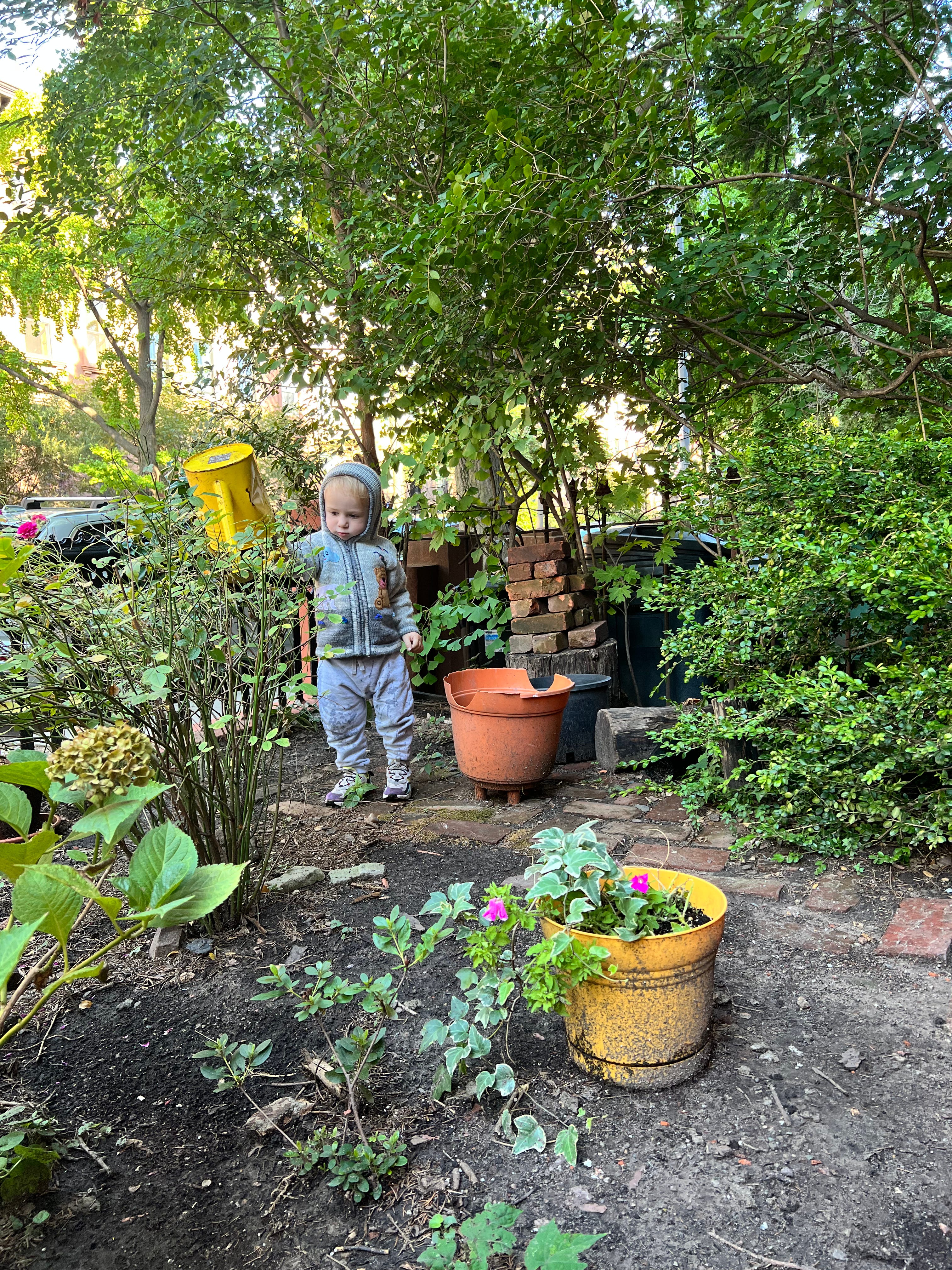
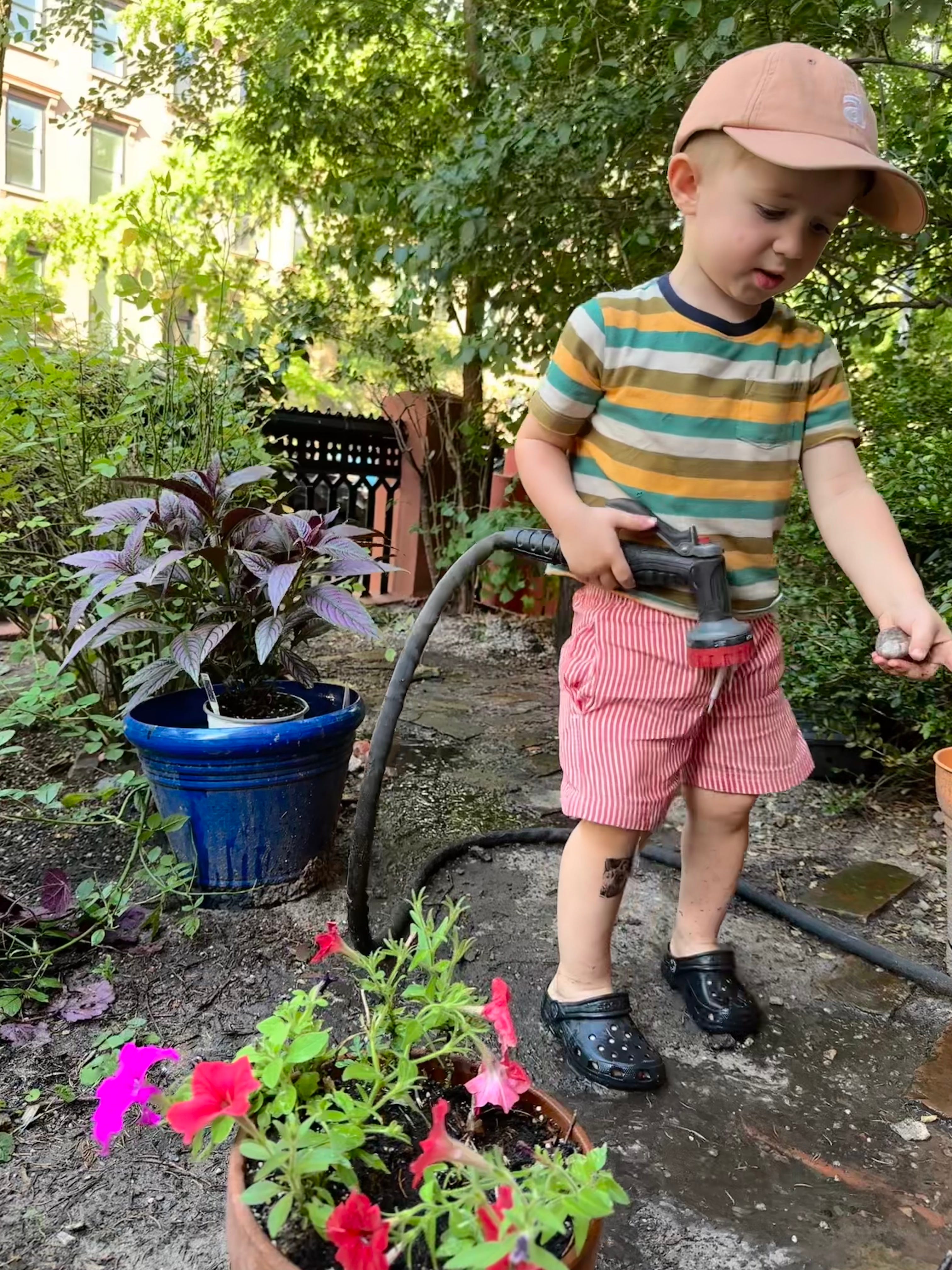
This conversation transpired on our last Friday in the apartment. My kid, Henry, was playing in the dirt – a small patch of garden to the side of the stoop. I watched him smash a large chunk of cement against smaller chunks for an hour. There were a dozen piles of dust by the time the old owner arrived.
Our new apartment is on the second floor, like our current one, but it won’t have a little garden. It doesn’t even have a stoop – just two steps. I used to complain about this garden. I often said that Brooklyn dirt wasn’t real dirt; it was dust from all the car exhaust and sidewalk garbage off-gas. But now, seeing the smashed cement on top of the dirt, I knew that wasn’t accurate. It was all finely crumbled rock, but it was fun nevertheless.
Speaking of things turning to dust, the same day our landlords gave us notice, our eldest neighbor died. Someone set a four-foot Mets baseball-shaped floral display on their stoop, where he waved to us over the last five years. He’d say, “Hi, baby,” to Henry. Then he did the same to our secondborn, Louis. Then he stopped calling anyone in my party “baby.” Then we stopped seeing him outside.
When the old owner of our building stood outside our garden, I saw tears in his eyes, too. But he also smiled. Our two inner experiences didn’t make for great chat, so he said, “Well, I wish you all the best!” I smiled and said, “Same.” Then a neighbor girl, Henry’s age, walked up with her dad and said “hi” to Henry. She told us she was going to have Italian ice from the bakery around the corner. I almost stopped them to share the news, as they were one of the few neighbors I’d not yet told, but it didn’t feel like time yet. With them, I knew our relationship would be the same. Smiles and greetings on the way to the school, where all our kids would continue to go.
As my eyes traveled from the little girl back to Henry in our garden, I caught the eye of a man whose gaze I usually avoided. A helicopter overhead cut off the words from his mouth, but I smiled, looking at his mouth and the American flag mask around his chin, as if I heard him. Then I heard, “I never used GPS, but I always got where I needed to go.”
I said, “As we always do, eh?”
He nodded back and smiled.
The thematic resonance occurred to me mid-sentence, and my eyes and face reddened for the second time in fifteen minutes.
He was holding a pizza box from the shop around the corner. My family goes there nearly weekly.
“Good old-fashioned fun,” he said, nodding toward Henry. “You don’t see that much these days.”
“Yeah,” I said. Then my red eyes welled up, so I just smiled and nodded. The unmasked man noticed, I think, because normally he didn’t walk away without a discussion of Jesus, but that day he did.
The day our landlords gave us notice, a different miracle happened. A baby was born down the road. I knew because there was a human-sized plywood stork with the infant’s name and birth date out front. They do that for people who’ve lived in this neighborhood long enough to know the person who has the stork. Or, that’s what I assume. We’ve only been here five years. It has been my kid’s whole life, though, so maybe their kids will have a stork if they stick around.
The baby was born in the apartment where Henry’s best friend’s dad grew up. Her grandpa reminds us of this most Tuesdays when we see him at school pick-up. The building is supervised by Larry, who does handyman work for our landlords on the side. He fixed up our apartment before we moved in and will fix it up after we leave. We met Larry at Thanksgiving at our landlord’s apartment, underneath ours. They invited us the year Louis was born. He was one month old and had never left this building. Larry smiled at our baby, which was when I noticed he was missing his front four teeth. He’s been smiling more and more around me these days. Like the other day, the day before my second encounter with the building’s old owner, when Larry gave me advice on where to move, despite knowing we’d already committed to a spot. He thought our rent was too high. He told me to speak with the magician who lived around the corner. He said he’d help me get a good deal. But nothing in this neighborhood near our kids’ school with two bedrooms goes for less than $6,500. “We even toured places for $10k,” I said, “And a dozen people applied on the first day.”
My husband, Joe, found our new apartment just three days after our landlord gave us notice. He’d spent those days looking at a dozen places in person, after surveying Zillow, StreetEasy, Compass, Craigslist, etc., etc., etc., and even combing back through the last two months of rentals, for information’s sake. “This is the best we’ll find,” he said, after we looked at the apartment without a stoop. But I wasn’t ready to commit, let alone consider. All I could see were the negatives: a 20-minute walk to school instead of 2 minutes. Joe said, “A two-minute walk isn’t an option anymore.” And I said, “But it could be, if we waited.” I wanted to wallow for longer. The grief of the news wore hard on me, but the stress of the instability wore hard on him.
A lot has changed around here since we moved in in 2021. The neighborhood now ranks among the 5 highest-rent areas, says the newspaper of record. So much so that the neighborhood we had to avoid when house hunting previously is now the one we can better afford. Our local pizza shop will change. Our local bodega, too. Our neighbors. Everything, really. And also, nothing. We’ll walk past our old block on the way to the same school. More importantly, we’ll be together, of course.
My kids were concerned about our things – the couch, their toys, the TV.
“We’re taking everything but the fridge and stove with us,” I told them.
“My stuffies?”
“Of course, the stuffed animals are coming.”
“My bed?”
“Yes, the bed too.”
But as the weeks between notice day and moving day went on, they started saying things like “I’ll miss this apartment. I don’t want to leave.”
I said, “I know, baby. I don’t either. But sometimes life goes on like this, even if we’re not ready. We just have to trust we will be when we land.” And they didn’t respond, which I didn’t blame them for, because even my own words felt insufficient for myself. So I said, “And if we’re not, we’ll have another cuddle.”
I’ve never found it hard to trust the universe. Even on notice night, I cried on Joe’s shoulder, but I didn’t want to fight it. It was sad. I didn’t want it. But it was what was happening.
There were many times in the last five years when I thought about leaving, though, and finding a bigger spot with more space, a dishwasher, and a laundry machine. But I knew my control-freak nature was trying to exert control during upheaval, like when my husband needed a new job. Or when my body shrank too much, then lost a pregnancy, then grew larger from another. So I deleted the Zillow app and made myself celebrate what I already had in front of me. The tiny apartment where we cuddled through thick and thin.
Once a move wasn’t an option but the only option, I didn’t seek control through action; I wanted to do nothing at all. My husband and I’s different coping mechanisms seemed like a positive at first. I could have a little cry and keep the house moving while he invested all available mental space into the house hunt. But once I realized that meant more major life decisions would be made without my direct oversight and direction, the quaint idea of being an easygoing woman who entrusted the universe and her husband to carry her through existence evaporated. The inner control freak had a death cry. I felt like a kid. I felt like a trad. I wanted to sabotage everything, subconsciously. But I didn’t. I chose to trust the man I found smarter than anyone I knew, the man I felt was meant for me in ways that defy the laws of probability, even though it felt like a knife in my gut, which felt like the first time I’d really trusted anything, ever.
I kept mumbling, “What if it’s the wrong choice. What if we’re not happy there? What if the little issues build into a big, unresolvable issue?”
Joe said it was the right choice. And if it were wrong, we’d figure it out.
I was, I am, afraid how a new space and a new neighborhood might rock all the good we have going. I can’t help but feel like our happiness is my responsibility. Self-dependence isn’t an issue, of course. Until, or unless, it pushes you away from the people you want to be happy with.
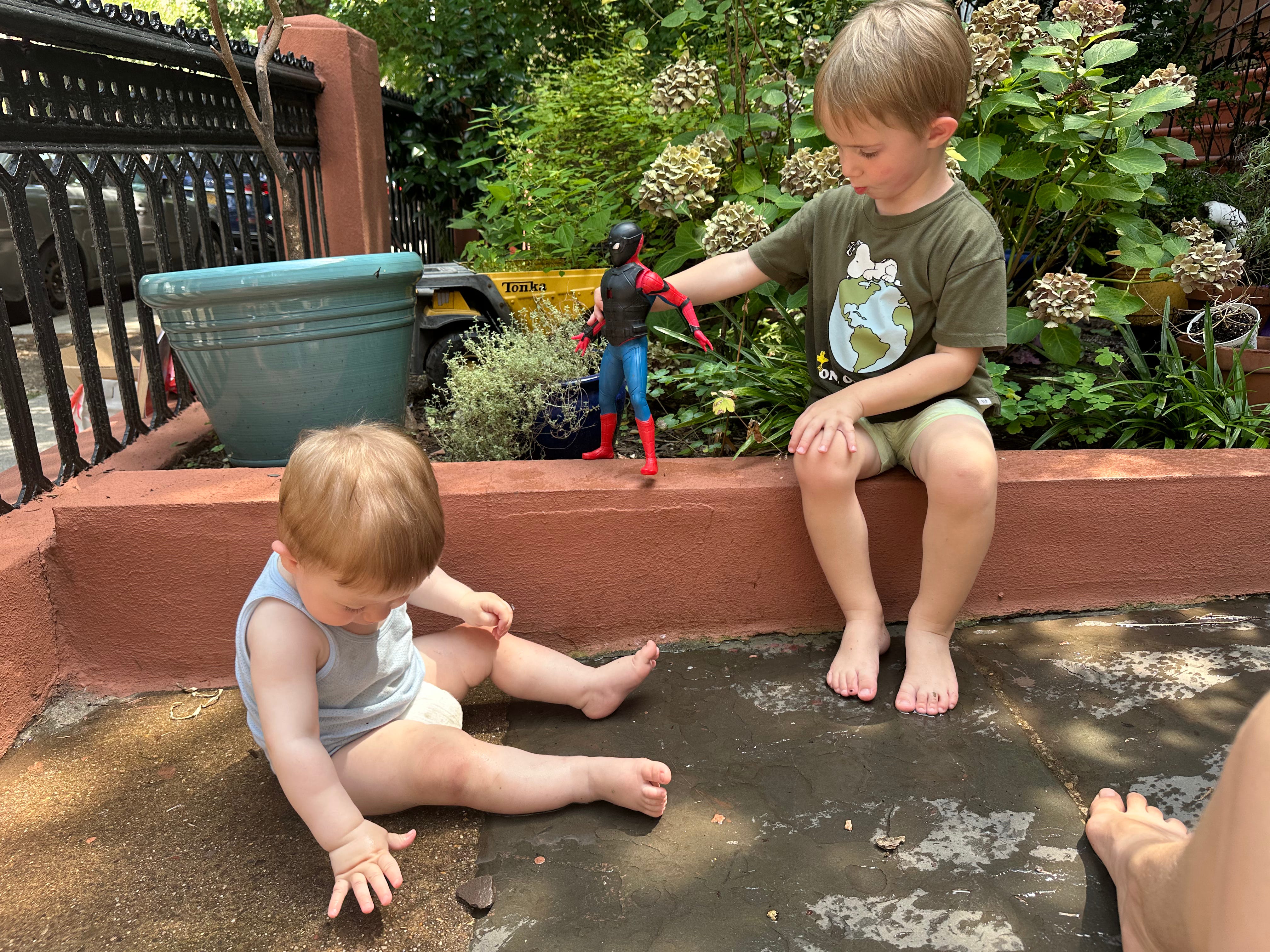
Last night, on our last Sunday at our apartment, all four of us sat out on the stoop. I picked up a pop for each of us from the bodega. Our kids ran over from the garden patch with dirty hands to collect their Martinelli’s sparkling apple juice. I tried to crack open the glass bottle of Coca-Cola for my husband on the fence, but failed, so we shared my Italian orange soda.
“I’ll miss our orange home,” Henry said.
“Home. Miss. Me too,” Louis said.
We packed all that weekend. Rented pink boxes with vacuum-sealed stuffed animals and board books in towers through our 750 square feet.
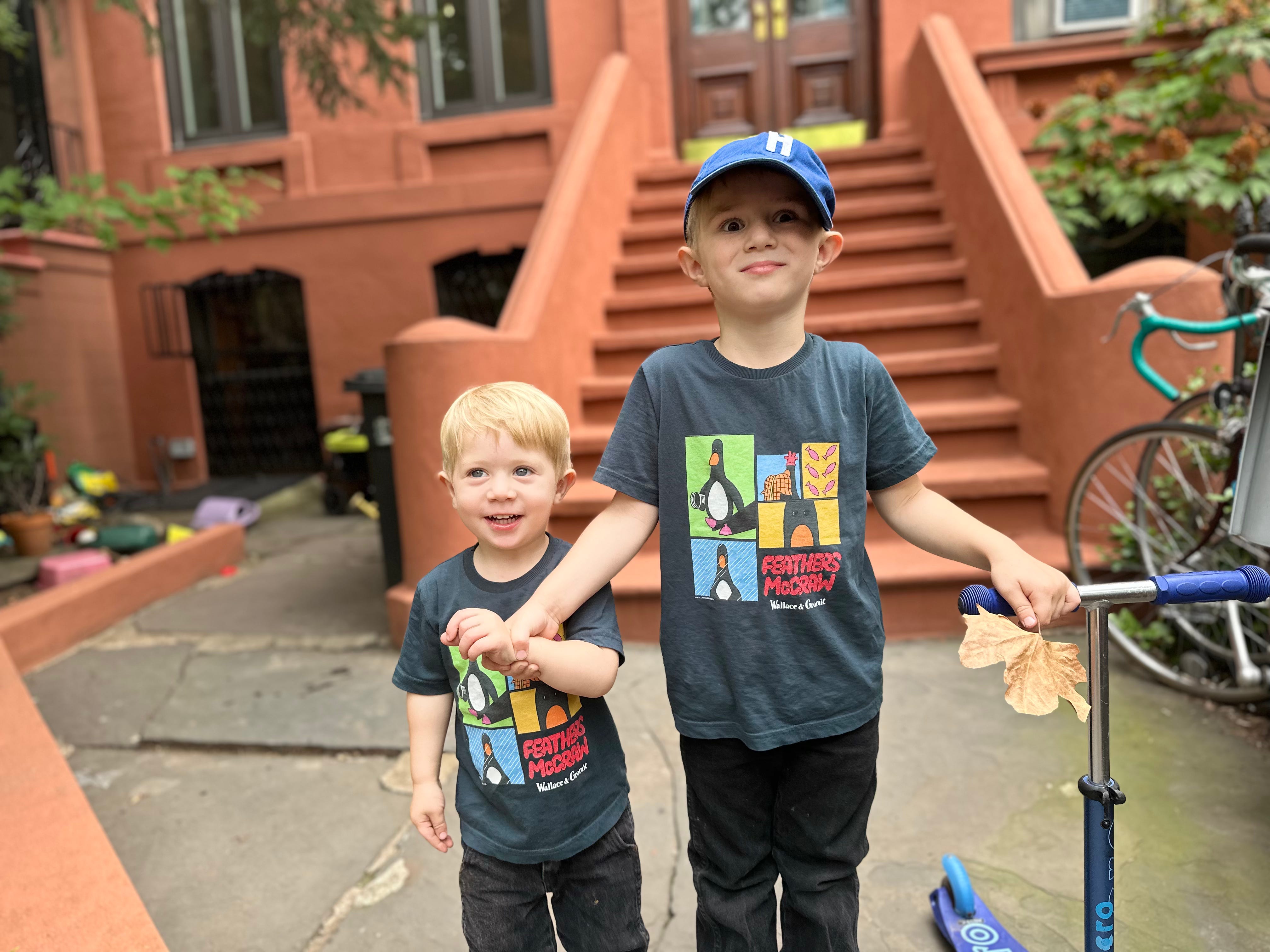
Our neighbor, Tom, a gay man in his 70s who was our kids’ first non-familial friend, walked up from their basement laundry.
“You’ll have your own laundry soon,” he said.
I smiled. It was true. Come Thursday, we’ll have a dishwasher, laundry machines, a few more square feet, and a view from the bedroom window full of trees and vines and fire escapes. We’ll be near Brooklyn Bridge Park and the Hudson River. We’ll have an office to sequester into during video calls.
When we told Tom about the move, he called our landlords rats.
“I loved living here,” I said. “They’ve been good to us. It’s just a bummer.”
He agreed.
Joe said, “We’ll still bring you pavlova. And Henry will come weed your garden.”
We gave Tom a homemade block print today. It was of a home with a flower. Henry wrote, “We’ll miss having you as a neighbor,” on the back. Then we saw that little girl come out of the apartment above Tom’s. Her parents said Tom told them we were moving. We talked about it, and I didn’t get red or teary. Maybe it was because I’d finally taken down all the kids’ art from our walls. Or that we’d reached a percentage of packing that made this home no longer feel like ours. Maybe it’s just the exhaustion, and the exhaustion-influenced argument Joe and I had last night. Or maybe it’s the Aeon card reading I did for myself and Henry’s best friend’s mom, which told me that I’d been viewing this move as a prison sentence, but it would create the opposite – not punishment and solitude, but togetherness.
I wanted certainty that we’d be happy. But how can I ever be sure of anyone’s feelings? All that mattered was being together. This tiny apartment did that for us because of its limited space. And of the life and death that transpired here. It’s hard to see how it could get better. But it’s always hard to see what you haven’t seen before. To get where I need to go, I can’t use a map.
The first time I met this building’s old owner, my boys crawled out of our wagon, and Joe hefted grocery bags onto his shoulders. The old man stood there, looking up at the burnt-orange-painted brownstone with his family. I guessed that looking at the home he spent twenty years of his life inside would feel a lot like looking back in time. You can’t be within what’s passed.
We wrote a letter to this apartment: Thank you, house, for taking care of us. We love you so much. You did a good job helping us grow and pop out our boys. We’ll always remember you fondly. We wish we didn’t have to say goodbye. But we know it’s time.
We each signed it: Henry, L~~~~~, Joe (Dad), Mom (Abby)
Maybe we’ll get to walk past in forty years. Maybe my kids will be tall. Maybe I’ll only reach their shoulders. Maybe I’ll remember when they only reached my hip, or were born from between them. I bet I’ll think about how lucky we were, we are. To be here. And to keep growing, together.

Thank you for being a part of my non-geographic community, and thank you for reading the ramblings of a tired mom who has bonked her head three times this week.
I hope that your world is more zen than mine, and if it’s not, or if it’s even more chaotic, know I’m with you.
All my love I have to spare xoxoxoxoxo

Great and very moving post. I confidently predict you'll love life in your new apartment ❤️
Hi Abigail-
Your piece is very moving, particularly when you write about how the pain of explaining the situation to your children, and then accompany the text with pictures of your adorable little ones playing so contentedly in front of the only home they've ever known. Many years ago I lived with my family in a house in Charleston SC that was constructed in 1845. As with any house so old, it was full of quirky character; I don't think there was a single right angle anywhere in it, for one thing. The night the decision was made to move to Texas, I couldn't let myself feel altogether happy because I was leaving a place I loved and the only house my children knew. But for some reason I started wondering about all the people who had moved into and then out of that house in the 160+ years of its existence, which was something I'm embarrassed to admit I'd never given much consideration to before then. I realized that, in a house as old as that one, it was almost certainly the case that some children had been born in it, and some people had likely died in it as well, and I realized that surely those people had a greater claim on ownership of the house than I could put forward. And thinking about these things for some reason brought a certain peace to me and helped me to let go of my feelings of loss. I hope that you and your family grow to love your new place even more than the old one, and I wish you health and happiness and peace as always.
Dave