


Here’s a POV: You’re in a POV.
The ‘POV’ content trend has been a cornerstone of feeds everywhere for the last five years. There are 92.5 million videos tagged as such on TikTok.
POV: You fell in love in Europe
You see a couple walking down a narrow cobblestone street, holding hands. Cut. They’re holding hands across a bistro table with flickering candles. Cut. Their leather shoes are touching under it.
POV: You won the husband lottery
You see a man in matching, tousled cotton pajamas, stirring eggs in a pot over the hob. Cut. He’s plating the eggs that look like custard with sliced avocado. Cut. He’s serving you at a wooden table with a printed cotton napkin.
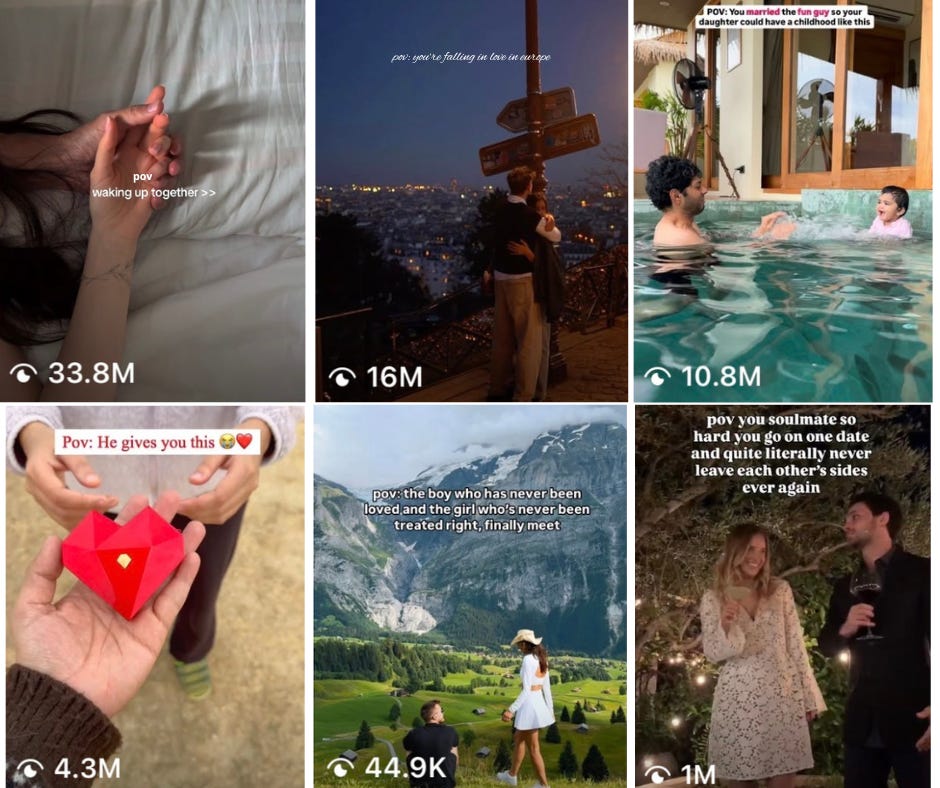
Is this love?
No, it’s a microscopic moment, a vignette crafted for external consumption. It looks like love. Maybe even feels like love. But romanticized love is not romantic love.
Romanticized love is a reflection of romantic love. It is a bite of, a perspective of, romantic love. A singular POV. Humans have always confused the symbol for the thing itself. Alfred Korzybski called it mistaking the map for the territory.
I’ve wondered if our collective interest in warm-fuzzy, low-attention, high-feels pleasure hits might be rewriting our understanding of relationships. Are we measuring our real lives by the accumulated impression of many 12-second POVs stitched together in CapCut with a soundtrack and text overlay?
It wouldn’t be the first time visual media has influenced reality. We can debate culture-first phenomena versus culture-back. But if you ask me, Romanticized Love may be, could be, inevitably will be, like how porn was something you just watched to see something hot and then became the way people actually have sex. Porn’s influence over the ways young people have sex has been more severe, given the limited sex education they’ve had in comparison to the availability of porn. But isn’t that what young people are experiencing – more romanticized relationship content and less coupling up?
Speaking of, POV is the 13th most searched term on Pornhub in the US.
Humans create culture, then culture creates us. And repeat.
It’s the sometimes-conscious, frequently subconscious human habit of mirroring what we see around us. Our desire to belong. To not stand out as someone worthy of being kicked out of the community.
Relatedly, in certain circles, relationship avoidance is en vogue – like Chante Joseph pointed out in Vogue with “Is having a boyfriend embarrassing now?” Where, in decades previous, one might’ve chosen boyfriends with the romanticized publicly consumable moments like an engagement ring and wedding photos in mind. The phrases we hear, the images we see, the messages we receive, all build into habits, fears, and ways to measure ourselves against our peers.
Even the push-pull breakup drama romanticized in Sabrina Carpenter’s lyrics is an archetype of romanticized love. Feeling the passion and pain of incompatibility is a script we might inhabit without considering how satisfying it is or isn’t.
We’re drawn to recognizable narratives of love like we fall into patterns of living.
But those recognizable narratives are crafted from simplified stories, single perspectives, POVs. They’re Romanticized Love – what looks like love, but isn’t always what love feels like. There is a small overlap in the Venn diagram of what love looks like and what love feels like. That overlap is a beautiful place, no doubt, but expecting to inhabit short-form, romanticized romantic love in a long-form life will leave you disappointed. And love, done well, has disappointment, but isn’t disappointing.
To seek Romantic Love, we must free ourselves from these limited perspectives. Question our values and what drives our beliefs and behaviors, evaluate our choice to have a big wedding or not, and consume media without letting it dictate our lives.
We can dig into our hearts, instead of our minds, where what we know is so influenced by what we see or consume, and ask what do we really want to feel? Is it just society’s approval, or is it endearing love? And if it’s the latter, acknowledge that that feeling cannot be completely communicated in short-form content. Love is complicated. Love is rich. Love has challenges. Love isn’t always aesthetic. And love is far more pleasurable than entertainment ever could be.
Love, with true feeling and not the rose-colored expectations of an unreflective mind, is between two humans, not archetypes, not ideas, nor vignettes.
Every generation has had to separate genuine desire from cultural prescription, which Erich Fromm argued was a requirement of genuine love. What’s new is the scale and speed of the scroll.
This requires investing more in self-understanding than in how others perceive us. To stop measuring ourselves against POVs. To stop trying to shape the perception of ourselves in others’ minds. To spend less time in the plane of perception altogether, really.
We need to leave the POV. Open our peripheral vision, too, so our eyes can appreciate the whole plane of possible sight, feeling, awareness.
So that when we watch a POV reel on our phones, we can enjoy the entertainment without using it as a model for our lives.

I do enjoy an Instagram reels wind-down. My feed is more comedic, educational, and politically active than the videos I’m referencing here. They’ve certainly come through, but all in all, I appreciate my algorithm. I think some of our time’s most creative and intellectual minds are using social media as an impactful tool. If you’re a social user, remember to craft your feed with your heart and mind in mind, and to always interrogate your desires.


Some on once asked me, “do you love me, or do you love the idea of me.”
The map-territory connection really hit it on the nose.
You‘re so right. We only see staged moments that last less than five seconds. How can we compare our long–form life to that?