


I once measured my marriage in minutes.
Who read more to our language-learning children. Who spent longer out of the apartment - his gym, my massage, his work trip, my dental surgery. Who came when.
I’d say, “You’ve barely looked away from your devices today.”
The more meticulously I measured relationship equity, the less satisfied we became. The fixation on fairness was poisoning our marriage.
Minutes turned to months when I saw the problem: I waited for fairness to fix me.
What I needed - what we both needed - wasn’t a symmetrical equation. It wasn’t scorekeeping but a kind of selfishness. A mutual selfishness.
***
Fairness is a fixation of my generation. We were raised to expect equality, fight for our place at tables, and never accept less than we deserve. These are good instincts with positive impact. But we conflated equality with sameness and fairness with symmetry.
We’ve even brought these ledgers into love - tools like Fair Play (a system for cataloging domestic labor) attempt to rebalance unseen work, offering validation. But they also reinforce the idea that a relationship should be audited rather than lived.
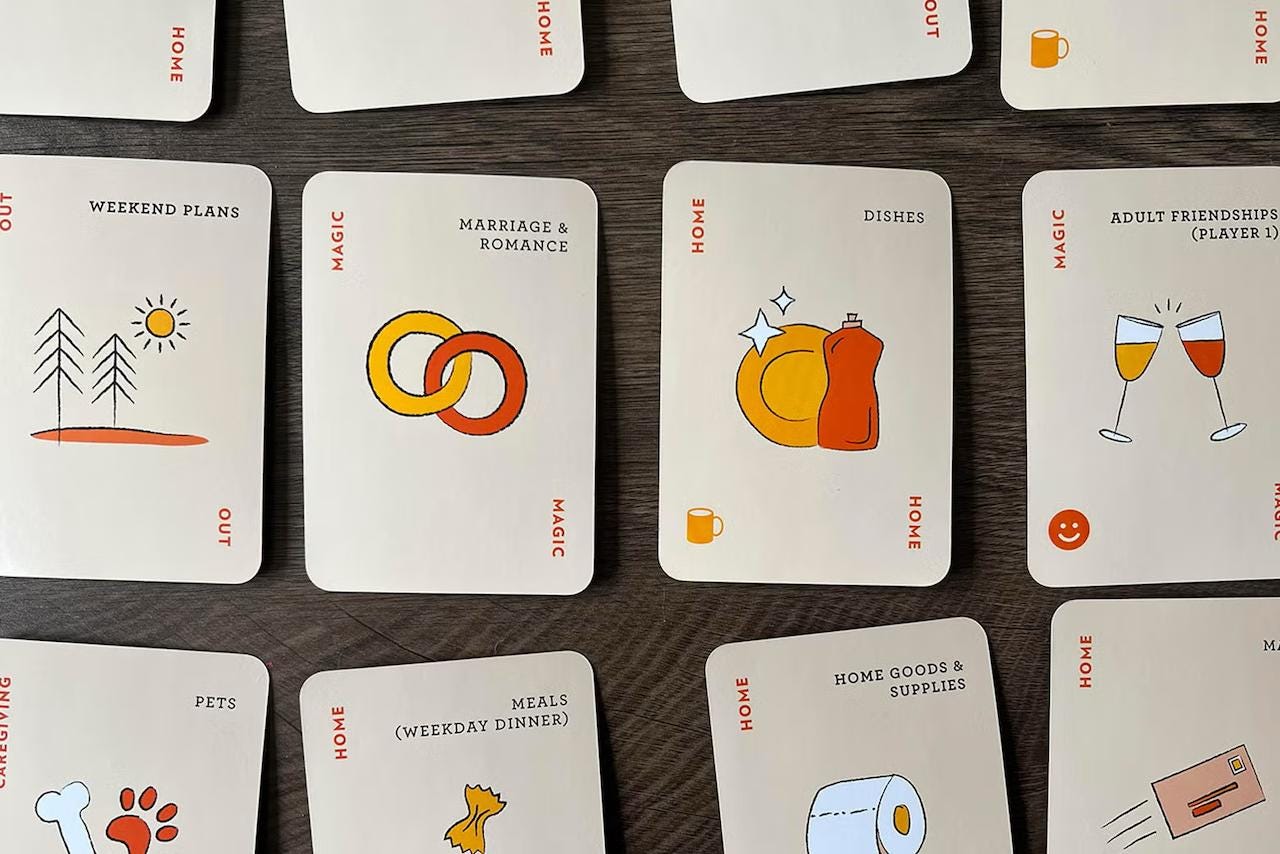
Constantly measuring your perceived equality against another keeps you looking outward - analyzing instead of appreciating, comparing instead of celebrating. It breeds emotional distance, reducing life to an equation needing balance.
In scope-keeping, I sought to justify my desires. I deserved an evening with my friend because he’d had a happy hour with his.
I wasn’t living for joy but for justice.
When I counted our minutes, we were struggling. Joe was stressed. I was stressed. New parent shit.
We wanted to be good parents. To him, that meant providing. He lost himself in that pressure. To me, that meant tending. I wanted togetherness. He wanted safety.
Our lives weren’t symmetrical, but they were balanced. I breastfed and navigated nighttime wake-ups. Joe cooked with a competence I'd never match. His higher-paying job took priority, making me the default parent. I cleaned because I saw what needed cleaning.
I enjoyed upholding my children’s immune systems and emotional safety. But sometimes, I worried I’d lost my place in the world. I envied Joe’s professional growth, mistaking his laughter with colleagues for enjoyment rather than duty. I blamed our arrangement instead of finding my own path to satisfaction.
That was my negative selfishness - resenting Joe for doing what made him happy instead of asking myself what would make me happy. My breaking point came when I judged him for going to the gym thrice a week. I felt ashamed. Didn’t I want him healthy, to live as long as possible? I had forgotten he wasn’t the enemy.
I was measuring a man instead of loving him.
***
I was born in the early ‘90s, a working-class American with that chip on my shoulder. I've always believed I could have anything if I worked hard enough - my cake in front of me and inside of me.
My British husband is a monarchist. “The British know from birth that life isn't fair," he told me. “We don't waste time trying to be something we can't. We just enjoy what we have."
Poor him, I once thought. But as I twist myself to be a present parent and a working mom, I see externalities eroding my peace.
There's a freedom in accepting that perfect fairness is a mirage.
Counting minutes is also only one way of measuring value. I count in minutes, but Joe does in dollars. Both metrics have validity but are incomplete. My husband and I could argue about the imbalance of either currency, growing indignant that the other doesn't recognize our sacrifice. Then we’d have two people simultaneously shortchanged by the same relationship.
Instead of looking out at Joe’s life, actions, and minutes, I needed to look at mine and decide if it pleased me.
I had to be selfish. A positive selfishness - where I take responsibility for my happiness and desires instead of demanding my husband mirror them.
When I looked at myself, really looked, I took better care of myself. I enjoyed my writing time, guilt-free. I meditated instead of analyzing. I didn’t try to answer emails while I held my babies. I did one thing at a time. I felt better. Then, I could be a better partner.
I said, “Do you know I would do anything for you? Really, anything.” Enough times, in enough ways, that he started showing me his selfishness, too.
We balance love not in rigid reciprocity but with responsive, mutual selfishness. We don’t compare, compete, or compensate. We indulge generously.
Joe brings me tea in bed every morning. He buys us surprise packages of lingerie. In turn, I’ve told him more about my longings instead of expecting him to intuit them.
Sharing selfish desires is the most intimate thing you can do. Being wholeheartedly selfish and asking your love to be the same is the truest gift of love. It’s showing them your self and letting them love you.
Fairness is a transaction. We choose desire-driven giving instead. It’s more complicated - it requires honesty, vulnerability, and looking within - but the payoff is great.
And after the evenings I give him the selfless blowjob Joe wants more than anything, after he holds me as we sleep, after he brings me tea in bed, he tells me he’s never felt more love in his heart. I know that I feel the same. That’s when I learned the thing I ought to have measured is wellbeing, happiness, love.
It was never minutes. It was always love.
Now, I say, “Are you feeling loved?” And I ask myself the same.
But I don’t need to count. Love just grows.
Soundtrack:
I do the same thing in my relationship. I know he does at least as much for me as I do for him. So that frees me from the burden of counting. I already know the score is in my favor. So I can just do things for him without doing any math. And I know, he has yet to disappoint me, that he will return it all with interest. If you're counting, you're losing. Glad to see this articulated.
Wise leads to lucky, and you are one wise woman!