


We’re made to have sex. It’s as primal as avoiding death. But, more fun. For me, sex is more than biology. Fucking fucking matters.
So what happens when someone obsessed with intimacy (me) hits that famously sexless season of new parenthood? Burning, swelling, destructive chaos. I’ll get to that. But first, my experience got me thinking about society. Specifically:
Chronic stress is killing American sexuality.
We’re in the middle of two oft-mentioned epidemics that aren’t separate. I’ll explain:
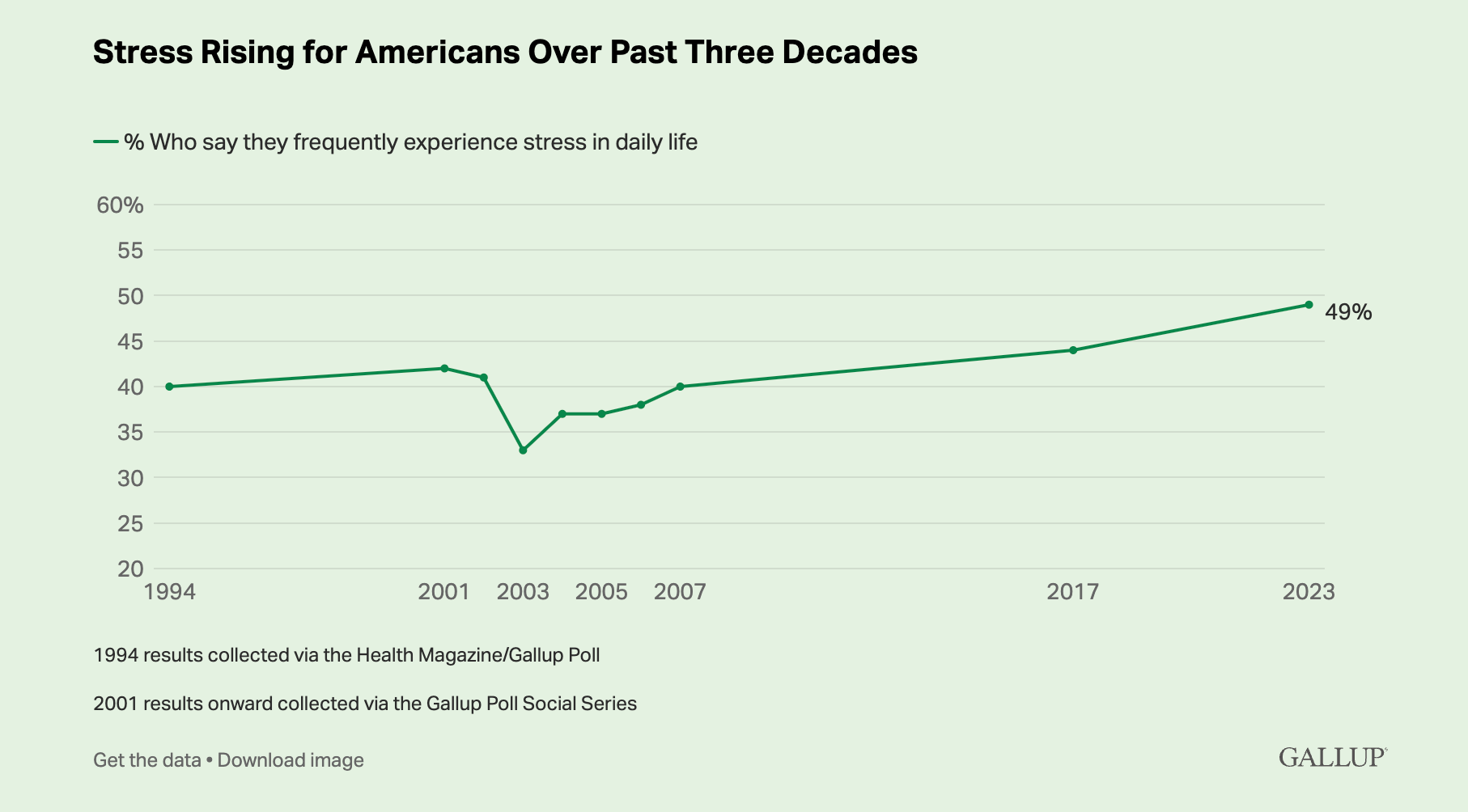
1) Stress levels, particularly among women and parents, are rising.
Americans are more stressed than ever before. In the 2024 ‘Stress in America’ report, one in three women rated their stress above 8 out of 10 — up from 24% in 2023, and just 19% in 2019. The trend line is sharp, and it’s climbing. The same report states that those taking the effects of stress the hardest are younger adults.
The Surgeon General warned that parents are facing a stress crisis. 48% of parents say their stress is “completely overwhelming,” compared with 26% of other adults.
2) Sexual activity is dropping.
Sex frequency is dropping amongst the partnered and unpartnered alike — it’s been referred to as a Sex Recession. The sexless rates are most pronounced amongst younger adults — those born after the 1980s — and amongst women. As I’ve written before, married people have more sex than single people, but those with young children are the least sexually active couples.
These two phenomena aren’t disparate. They’re connected. Most people know sex is a stress reliever, but did you know stress is a sex inhibitor, too?
3) Stress is directly connected to sexual dysfunction.
Stress kills sexuality in multiple ways. It’s a U-shaped relationship.
During healthy sexual arousal, cortisol — the stress hormone — either decreases or remains flat. Stressed women show the opposite pattern. Women with too much cortisol have inhibited arousal and cortisol spikes when sexually stimulated. In men, high cortisol levels are associated with sexual dysfunction.
Chronic stress creates a different problem. Long-term stress system exhaustion leads to HPA axis burnout and too low cortisol, which causes chronically low desire and sexual dysfunction. Chronic stress interferes with the part of our brain associated with arousal, it disrupts hormones, it creates psychological distraction, and even impacts our immune systems, which makes us more prone to microbiome changes, illness, and injury.
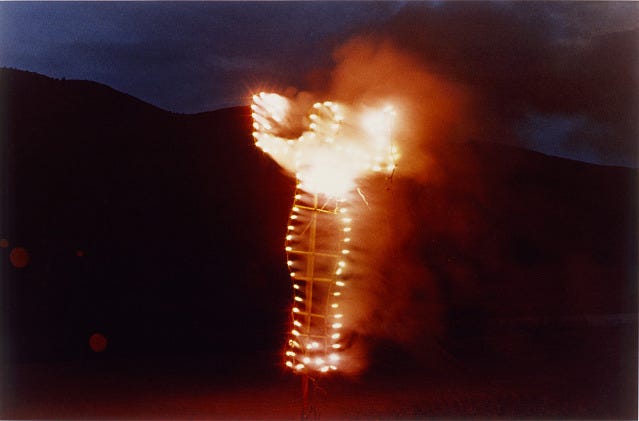
Stress is a biological cockblock.
Sex may be a fundamental human need, but pleasure isn’t. Optimal orgasms are incompatible with alarm.
Our nervous systems can't distinguish between a predator approaching, a ‘Can you hop on a call?’ Slack message, or our infants’ wails. They all trigger the biological response to shut down everything non-essential.
That’s just biology. But I read it as a personal failure instead of a physiological truth. I wanted to be the exception to the ‘sexless new parent’ rule. I wanted an exceptional sex life. So I didn’t listen to my body. Until it made me.
Pregnant, while working and raising my firstborn, I was uninterested in coming. When Joe went down on me, I felt nearly nothing. I was a torso’s length from interaction, left alone with my mind, which was consumed with maternal duty, body dysmorphia — things that were harder to turn off than my clit was turned on. But making love made me feel love, and I didn’t want to stop that expression of self. Neither did I want to ignore my partner's desire. I didn’t want it to impact our relationship. So I let the stress of the stress stress me out further. In that prime sexless season, I doubled down on sex.
If our two schedules were clear for at least ten minutes, and the baby was asleep (or sometimes regardless), I’d initiate a quickie. I ‘solved’ body dysmorphia with a green leather harness. For vaginal dryness, I researched and bought pregnancy-safe organic lube. We fucked far more often than one might expect of expectant and new parents, and certainly more than my vagina anticipated. Then one day, it decided it didn’t want to anymore.
Shortly after a pre-meeting pounding, my vagina burned. It *burned*. I knew fire couldn’t exist within, but I wondered. Briefly. And then briefly again. And again. Until those brief moments became an unreasonable amount of time, and the unreasonableness carried on with itself long past a doctor's appointment. Stress fried my brain. I ate an arms-long baguette, forgetting about yeast’s impact on, well, a yeast infection. Everything burned.
But I still didn’t listen. When I couldn’t be vaginally penetrated, I didn’t worry. Skin heals, pH rebalances, and blow jobs were always an option. Until they weren’t. Within a couple of weeks, my throat closed, too. It swelled so I couldn’t even eat a smoothie without choking. I gargled salt water so often that my lips cracked.
Even the stressed, burning, swelling body finds rest. It’s called sleep. I came so infrequently while awake that I had sex dreams whenever I hit REM. Which, with gratitude to co-sleeping, was more frequently than you’d think.
I treated my sex life like a productivity problem instead of addressing the root cause — my stress life was hurting my sex life. And I believe that’s exactly what our society is doing, too.
Americans are sold a dream: that with enough effort, we can build the life we want. But if you’re always chasing dreams, you might miss the life entirely1. Just the chase remains — the fight, the flight — and you might only be coming in your sleep.
I learned to come again by losing my mind — and getting back into my body (over and over again). When I did that, I recognized that the drive to do, fix, or solve was what really cockblocked my pleasure. No amount of sex toys, scheduled intimacy, or lubricants will fix a nervous system that's been hijacked by chronic stress. The path to better sex isn't doing more. It's doing less.
The U.S. is too manifest and not enough destiny. We think the power is in doing, but the real flex is in acceptance. In presence.
New parenthood is sexless by design2. Stress happens. Our bodies know what to do with it. Thus, some seasons are light on lovemaking. But life itself shouldn’t be (remember that starting sentence). If the urge is missing from your life, ask yourself if you’re just surviving.
If you’re bunt out, maybe it’s not because something’s broken in you. Maybe it’s because you’re living inside a broken idea of what a life should be.
I don’t care about being an exception to any rule anymore. I’m okay being normal — just not the stressed, sexless type of normal. And I’m glad I figured that out before anything else burned.
I hope the same for you. If you’re not there yet, be easy on yourself. You’re only human.
Soundtrack:
Even this country's analysis of stress focuses on productivity – the study on our collective psychological break is called the “Work in America Survey.”
That doesn’t mean new parenthood lacks intimacy. In some ways, it was the most profoundly intimate, soul-baring, sexy, and raw time I’ve ever had. But it is a stressful period, and that stress needs management. I have tips on Postpartum Intimacy over here.
Very well written. I think that the stress experienced by new moms is nature's way of hyperfocusing her attention on the new, helpless baby in order to maximize its chances of survival, and inhibition of sexual desire is there to prevent mom from becoming pregnant again while she still has her hands full with a newborn; same reason the menstrual cycle stops during breast feeding. And I love the line about how Americans are taught that they can achieve their dreams if they just work hard enough. Reminds me of the last couple of sentences of the Great Gatsby.
“If you’re burnt out, maybe it’s not because something’s broken in you. Maybe it’s because you’re living inside a broken idea of what a life should be.” ❤️