


My marriage is not immune to the national misery index.
My husband and I have our share of personal complications, like everyone. But I’ve found the meatiest bullshit – the sort that really stinks – comes from outside. Recessions. Mass layoffs. The boring world-ending phenomena that connect us all.
The Greater We were struggling a few years ago, you might recall. We were, too. I look back on it as the hardest year of our marriage.
Joe had a freak confluence of events. An Englishman, freshly settled in New York and confronted by America’s honorless, fuck-you business culture. A new dad, accosted by that primal, paternal protection panic. An indie creative dropped into corporate hell – a BIG HOLDING COMPANY where no one cared about the actual work, just saving their skins.
I was navigating postpartum health and becoming a mom, but the hardest part for me was watching Joe suffer, not being able to help, and missing the help and companionship that I’d come to depend upon from him.
I can still see his face, sitting in the dark, illuminated by blue light. He was a few months into a new job when the layoffs all began. He started working longer hours until it felt like every waking hour. Weekends didn’t exist anymore. Neither did vacations.
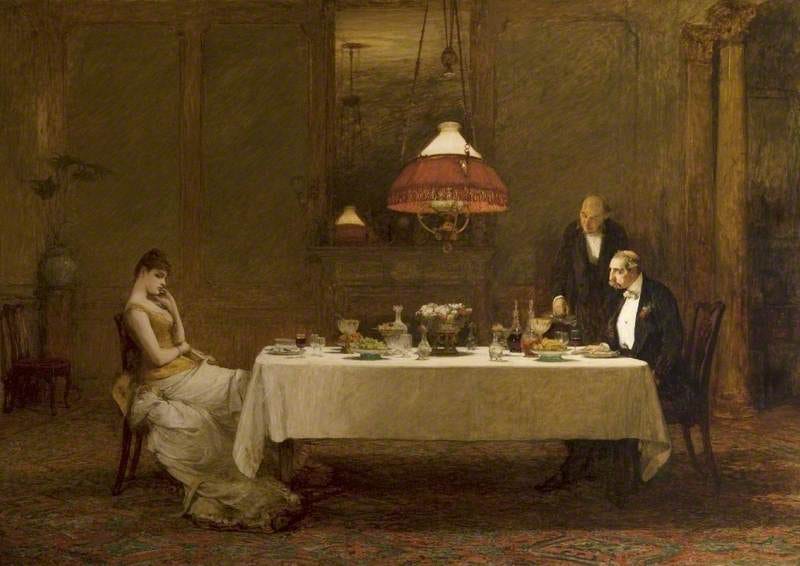
It was a big change for us. I remember seeing an iPhone photo memory update from the year before. It was his face, in a pub in London, with every tooth involuntarily showing. I realized I hadn’t seen him smile in I didn’t know how long. We hardly even made eye contact. He looked past me, through me. His problems were beyond me. His brain was too busy even to hear me.
I remember saying, “Did you have an idea for dinner?”
He tapped his fingers as I spoke. No key stuck. Nothing got in the way of his work.
“It’s getting late,” I said. “Our kid needs to eat,” I said. “I’ll make something,” I said.
Normal him wanted to be in charge of dinner. Normal him enjoyed cooking. Normal him sometimes needed the reminder to pull away from a project to where he preferred to be.
I filled a pot with water and put it on the electric stovetop. The coils turned previous dinners’ residue into char, and I smelt the smoke. He must have too.
“What are you doing?” he said.
“I’m making dinner.”
“What are you making?”
“I still don’t know. But I’m boiling water.”
“I’ll make something,” he said.
I lingered in the narrow kitchen, waiting for him to get distracted again by one of the phone notifications that never stopped. Then I waited to see if he noticed me.
“Well,” he said.
“Yeah?” I said.
“Are you going to let me?”
“Let you?”
“Cook.” He motioned with his hands to ask me to move.
I walked out of the kitchen and watched him grab things from the cupboard and then the fridge. His face was a stone. His phone buzzed in his pocket. He left cupboard doors open, and they intersected with each other, clanging when bumped. The handle on the utensil drawer came off, and he set it inside the drawer.
“What are you doing?” he said.
He wasn’t looking at me.
“Watching you,” I said.
“Yeah,” he said. “It’s creeping me out.”
“I just worry about you,” I said. “With all the work.”
He said I was naive. That I thought love could outrun capitalism, or something. He wasn’t all wrong. I wanted to know we had a plan for the discomfort. I talked about having him quit. Having us move to Minnesota. But really, I just wanted to know that he was still the carefree, English slacker who ditched the office by happy hour. I wanted him to know I wanted that him, again. But I wasn’t reading the economic statistics he was. I didn’t know what it was like to be a new dad and an Englishman in the US during a recession.
It wasn’t all bad, of course. We made grocery shopping our regular family outing. It sounds mundane, I know, but that’s what I liked about it. It was dependable, routine, ours. We established our ‘fundamentals’: always kiss before bed. We still had good sex, and quite often, too. We were still us. Just stressed. Just busy.
The more hours devoted to work, the fewer for family. The more mental load demanded by stress, the less mental capacity there was for pleasure. The less love we felt, the less love we had to give.
He became too busy to touch my shoulder as he walked past me. Then maybe I didn’t bring him a cup of tea as frequently. He said fewer sweet nothings. I felt unloved. He felt unloved. I don’t know who did it first. It doesn’t really matter.
All my worries about our life turned to annoyance, then anger. He wasn’t prioritizing the family anymore, I thought. I didn’t feel loved.
He and I were on a Subway track when I realized where we were heading – two absent people who could sooner forget what presence looked like; forget who their partner was, let alone how much they enjoyed them. He and I were riding into Manhattan, staring off in different directions. The train jolted, and I lost my balance. I wasn’t very grounded then. The stress of our load and the imperfect postpartum healing ate away at my body. I reached out, grasping for a pole to hold myself up with, and in that fear state, our future as strangers flashed before my eyes. I knew then that I never wanted to be a stranger to him. I knew I’d keep riding out our misery until it broke.
But I didn’t know if he didn’t want that either.
That evening, after our baby was asleep, I remember crying cross-legged on the dining room rug that was long soiled by fallen avocado. I pleaded with my husband.
“Are you happy?” I said. “Is this how you want to live?”
He was defensive. He kept staring at his screen.
“I’m not trying to blame you,” I said. “I love you. I want you to be happy. Is this what that looks like for you? All this work? All this stress? All this distance?”
I wasn’t always so kind. His defensiveness was sometimes warranted.
Cross-legged, I said, “I’m not happy.”
“You’re not?”
I sobbed. I blew my nose into the hem of my nightgown. “I’m sad. I miss you. I miss my lazy, slacker husband.”
“It’s easier in the UK,” he said. There we hadn’t been parents. But it was more than that. He reminded me that in the UK, you could call your boss an asshole for months before someone would then fire you, at which point you’d then have months before you were out of a salary, and at which point the government would help you out a bit while you were looking for the next position. There, then, there wasn’t a recession.
“I know,” I said. “But it doesn’t have to be like this. You can find a new job somewhere else.”
“No one is hiring,” he said. “Thousands of people are losing theirs every week.”
“We can figure something out if we’re in this together. Not this shit where we’re withholding love.”
“You’re withholding love,” he said.
“You are too.”
“Yeah.”
“Yeah.”
His eyes were soft now. He looked so exhausted. I felt his pain. And I felt exhausted, too. I think he saw that.
“I love you,” he said.
“I love you too.”
He came to me on the rug there, and we hugged. It didn’t get easier right away, but it did eventually. We were learning how to communicate through our pain still. How not to give in to the cycle of withholding, and how to be there for each other when things get tough. We were also both becoming ourselves.
Joe was going through a career transition. Plus, finding his footing in this country’s business culture, amidst the fluctuating economy. And he was learning how to be the dad he wanted to be amidst it all.
And I was figuring out how to balance being a mom with the other parts of myself – the part that wanted to be a great partner, have a career, express myself creatively, and feel, somehow, independent while no longer alone. I was learning how to let go of control and be part of a team. Before getting the balance right, I vacillated between the extremes of the spectrum – from gripping control and looking for ways to fix things, to giving control up completely and being powerless in the face of circumstances.
All while life went on, as it does. We bought groceries and watched the cost increase. We ate meals, mostly all together. Our kid, Henry, grew. Joe built Lego with him, and I brought him to the park. We watched the seasons change. We got sick, building Henry’s immune system. I was thinner than I had ever been. We visited family. We had sex. I got pregnant. I had a miscarriage.
I worried about his health. I worried about my own.
I got pregnant again. We were excited. We knew things would be great.
Joe kept overworking, then added in the overwork required to find a way to stop overworking. He applied, then interviewed for new roles in Australia, England, California, Texas.
The potential to move terrified me. I wanted to know where and when I’d give birth. I was hormonal. Every little thing felt more important to solve. I was more desperate. But I couldn’t even talk to my partner when I wanted to. He was so busy. I missed him so much.
I remember calling my best friend for advice. I felt blinded by all the shit. How the Canadian forest fires made the sky pink. The air quality. My baby’s lungs and brain development. Joe’s global job hunt. My health. Our relationship. The misery. I laughed, too. I felt crazy. I told her how I knew everything was fine, but why didn’t it feel that way? She gave me the therapist line: focus on what you can control. I laughed again. I knew it. We all know it.
Then I did. I started taking better care of myself – resting when I needed to without feeling guilty next to his nonstop slog. I went to see my friends even though I felt guilty for leaving him blue-lit at home. I joined a writing group that met online in the evenings after our kids went to sleep. Joe and I were both behind a screen those evenings.
I modeled what I wanted him to do, too. Sometimes he found my actions frustrating. But I could also tell he knew that was a problem. That he knew he didn’t want to find my life a problem. This was the start of our mutual selfishness pact. I did the things I needed, for me, knowing he wasn’t ready for his end of that arrangement.
I ignored our future. I focused on the moment. I found a midwife practice whose philosophy centered on the mind-body connection in birth. They were just down the road from us. It felt meant to be. Joe and I loved them. We prepared for the birth together. With their help, we talked through the trauma of our firstborn’s birth. How distant the experience made us feel. How we knew that feeling stayed with us.
Our baby was born. In New York, in our apartment. We did it as a team. Joe was behind me every step. He literally held me up when my legs were starting to give out. He wiped shit off my butt. He texted the midwife an indirect, un-American, “shits getting real.” He nearly caught the baby himself, but our midwife ran up the steps before the final two pushes. It was incredible. We were a team.
I stayed in bed for two weeks. Joe fed me broth and cottage pies. He played guitar for us all. I hadn’t seen him play in over a year. He cared for me and our eldest, as I cared for our newborn. I remember once lying the tiny one on the ground as Joe and Henry built a Lego castle. I remember Joe grinning so wide with the two boys then. The light was golden. I took a photo.
Joe got a new job soon after. He took a pay cut and a less prestigious title at a remote company. He cared more about spending time with our family.
We never moved.
That was two years ago.

Ever since, everything has only gotten better.
Misery comes for us all, and we found our way through.
Sure, we added our own personal problems to the greater world’s. We might have nitpicked, taken too much time to measure each other’s physical and emotional contributions to our team, questioned who was supporting whom, and when. We withheld from each other.
I thought of that time as Joe’s crisis. But I was having my own, too. I battled myself and blamed him.
But when I look back, I wouldn’t have it any other way. We both were in that season of figuring out our new selves. I accepted my role as a mother and rejected the notion that motherhood was limiting. Joe’s career is unstoppable now. And he’s a great dad.
No one – whether you’re in a relationship or otherwise – is off-limits to these external storms. I’d rather weather them with someone by my side, in my home, in my bed. Even if, as we’ve found, amidst the storm, we might find little ways to make our lives even more miserable.
Misery indices will fluctuate. The outside world will keep demanding. We’ll have these seasons.
Lately, Joe’s been busy. Very busy.
I recognize the way he gets quiet, focused, the way his laptop and phone are never far. The work slips into the weekend. I recognize how I start considering if it’s been too long since the Legos came out. I recognize the way my gut drops when he walks past without that touch on my back.
But I know if it gets to the point of misery, we know how to get back.
The things we learned that year, like our birth experiences, stuck with us. And unlike national economies, which don’t have minds or bodies, we can learn from the misery. This time, if there is a this time, we know how to be there for each other. And, most importantly, we know that we want to.


One of the first pieces that really ‘took off’ for me on Substack referenced this difficult life phase. It’s called Stranger Spouse, and I’d encourage you to read it if you haven’t.
I also recently wrote about how Joe and I reconnect when life gets in the way of love, which shows how we now handle busyness and disconnection now.
I'm glad you found your way back from this. It doesn't always happen 🫤
This was beautiful. Thank you for sharing!