


Welcome back to Happy Endings, where I, a sex tech marketer and monogamous married mother of two, discuss contemporary love and provide a peek into my relationship.
Astute subscribers noticed that I offered the opportunity to answer their questions anonymously. This is my first time doing that.

Dear Abigail,
What makes a good man?
Thank you,
[Redacted]
This is not the first time I’ve been asked this question. I have an answer.
But first, some backstory:
I was on a panel discussing masculinity a few years ago. And last year, a research company interviewed me for a report on the gender’s changing aspirations.
I care about masculinity. I grew up with a single dad (my mom died young). Thus, masculinity almost feels like my north star.
Though a decade ago, I wore a pin that said ‘male tears’ because I felt angry about the state of our world and developed a blanket resentment toward men. When I was pregnant with my first, and the lab tech let the pronoun ‘he’ slip, my stomach dropped. It bothered me that a fetus’s genitals could give me such a reaction. Since then, I’ve worked to remove my gender bias. Now, I have two young boys, and I write about loving my husband, unironically, because I hope an example of love could spread love, and love heals.
To that end, I invited my husband, an intermittent commentator in the Happy Endings universe, to join the conversation. It (d)evolved into a lively chat about the evolving forms of masculinity, from the Middle Ages’ ‘Nine Worthies’ to Boomer hatewifing to wife-guys.
I hope you enjoy:
Abby: Babe, what makes a man a ‘good man’?
Joe: Lawrence of Arabia
Incredible intellect, charisma, but awkward with it. Eccentric
Deeply uncomfortable with authority but at the same time not anarchic
Self deprecating
Above all…Obviously has his issues, but he overcomes them by virtue of pure interest in the world he ventures into
Like, he is highly useful in the world, but by virtue of him paying attention in ways other people are not
Abby: Not a wife guy?
Joe: Ha
Abby: I’m only a little kidding. Your answer is very you.
There are many varieties of ‘a good man,’ right? You Englishmen love honor. My Midwesterners love responsibility.
I find it interesting to study the style of men that captures our current culture’s attention. Aspirational masculine codings wax and wane through archetypes, not all of them good. We can learn much about what society values by studying who has fame.
I think one of the positive archetypes of now is the wife guy.
Joe: [dropped a Wikipedia link to the Nine Worthies — nine men of the Middle Ages who exemplified chivalry such as Charlemagne, Caesar, and Judas “The Hammer.”]
Abby: Fascinating.
It would be fun to craft a modern equivalent. As a generous alternative to the ways incels categorize men (Chad, Beta, et al.)
But really, do you think you’re a wife guy?
Joe: Maybe
But the whole idea of wife guy is a reaction / hangover to either boomer hatewifing or the milder golf/fishing, general wife avoider
The idea that a bloke who likes his missus is weird and deserves a name proves the point
Abby: Yes. I can see that arc of history.
Hopefully, eventually, being a wife guy won’t warrant a label. Like how we called guys who take care of themselves metrosexual in the aughts.
Joe: We were chatting about the whole boomer ‘i hate my wife’ humor in a WhatsApp group the other day
Abby: Send a screenshot
Joe:
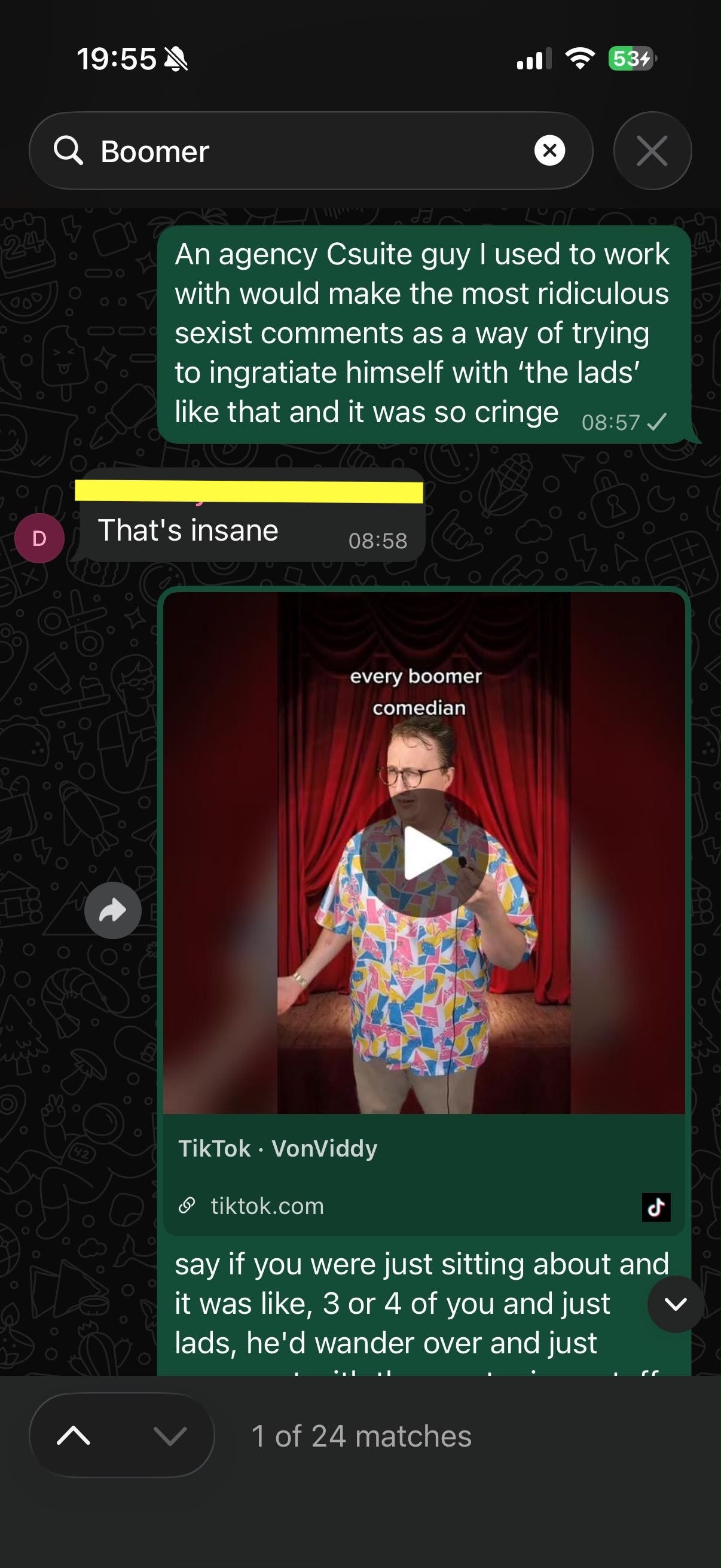
We were just talking about how cringe bosses do stupid shit to try and seem cool
Abby: Why do you think they joked like that at all? Were they actually unhappy? Was it just bully-humor — pushing away what brings you pain? Prodding at the ‘weak’ to seem ‘strong’?
Joe: Weirdly, I think it was a pride thing
It’s like ‘I must be a great husband to put up with this’
Martyr complex stuff
It’s the same as people at work glorifying their busyness
Abby: Mmm yes, it stems from where their own life dissatisfaction and their insecurities overlap.
The wifehater is insecure that their wife might not love them, then arrogant because they feel they deserve her love.
Joe: Yeah
Controversial opinion. But I think certain polyamorous types show a modern expression of that martyrdom
Like [Redacted] and his ex
Abby: Explain
Joe: She was feeling jealous, and [Redacted] said that is natural and normal
But any functioning person knows it’s not normal for your partner to rub your face in things that upset you
So it’s worn like the same arrogance
Rather than ‘I hate my wife and put up with her’
It’s ‘I love my partner and encourage them to hurt my feelings’
Abby: lol wild
Joe: I’m such a good person that I willingly let someone make me feel bad, but deep down probably deserve it, but that makes me a good person
You get what I mean
People using the relationship to feel good about themselves for enduring it
Abby: This felt like a deviation from our subject, but it is actually exactly on. Being a martyr is a negative way of being a ‘good person.’
And this brings me to one point I wanted to discuss here. I think that one marker of a good man, or a good person, is the capacity to unconditionally love.
And to our point here, people who exhibit martyr characteristics often didn’t feel well loved as children.
Joe: Maybe it’s parental love, or maybe not. But there is something psychological to it
Abby: Sticking it out to prove a point. What would Freud say 🤪
Joe: I think it’s like a sliding scale there though
Sexbored marriage is like the mildest - I soldier on because I am a good person
Then up a level is boomer humor hatewifing - I soldier on because I married the old bag
Then the final tier is the ‘struggle-session maximally ‘sit with your feelings’ style’ polyamory, where it’s like, “I don’t even hate them; I encourage them to make me feel bad — I’m that much of a virtuous person”
Think it’s probably down to a psychological thing of needing to feel like a good person being intertwined with suffering
Abby: I’m curious about this idea. Suffering is so interwoven with many age-old cultural ideas of goodness. But I really do oppose this definition.
Like perhaps pain and suffering are on one end of the spectrum, and success and power are on another, and somehow people think that being a ‘good man’ falls somewhere on this spectrum, but ‘goodness’ has nothing to do with the spectrum at all.
I’ve been thinking a lot about what I’ve dubbed ‘Columbo Masculinity’ lately. Maybe because he reminds me of you.
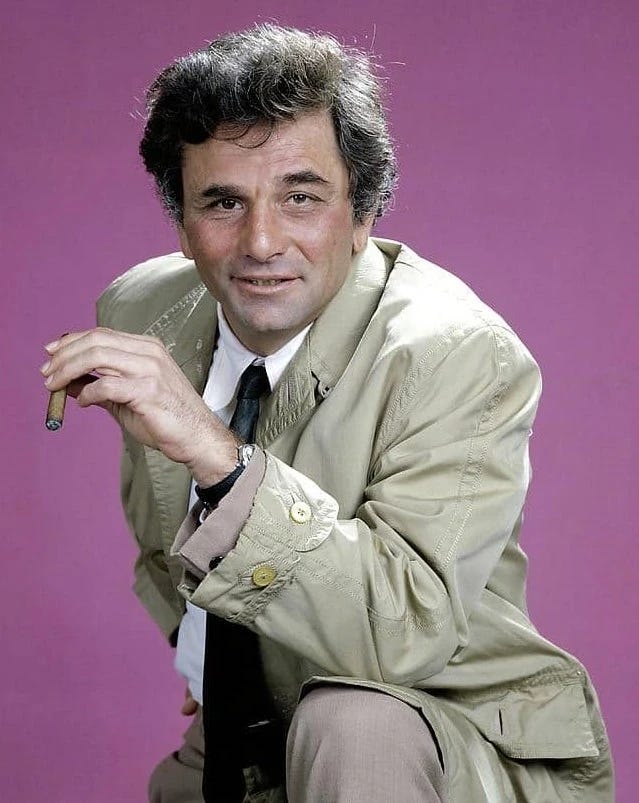
Columbo is clever, but he doesn’t need to be seen as such. He is comfortable and confident in himself.
And Columbo is absolutely a wife guy.
Joe: Yeah, though you never actually meet her…
Abby: It was the ‘60s. The wives were still at home :(
You may find it cringe and all, but I think you are a wife guy. I overhear you on your work calls talking about me.
And even if we ought not need a label for this sort of aspirational archetype, I think it’s positive. As you’ve often said, marriage is good for a man (statistically, both economically and criminally), so if we hope, as we do, for a more positive life for future people of all genders, a moment in time where a wife guy reigns trendy is net positive. In fact, it may be the counterweight to the whole manosphere.
Joe: Well yeah, I think the manosphere is downstream of a lot of economic and cultural things, and some of the stuff they point at as a problem is definitely true; it’s just that their solutions are completely dimwitted and stupid and pointed at the wrong things
If you step back and look at the economy, then it’s never been less rewarding to work for somebody else; the capital-owning classes gobble up more than ever - have women’s wages gone up a little bit at the same time? Yeah, but it’s not the women who are the issue. It’s Jeff Bezos - who, last time I checked, wasn’t exactly a feminist icon (though he did launch Katy Perry and his wife into space as a statement of solidarity with womankind)
But yeah, wife guys are trendy - but the issue is that these days the untrendy and vapid people (e.g. the manosphere) have a way bigger platform
Abby: Too bad the wife guys are getting laid too often to master the clickbait short-form video
But, speaking of the future, what sort of man do you hope our boys will be?
Joe: Free thinkers. Have verve and elan. Not easily led. Cheeky, charming, irreverent. Don’t take anybody or anything too seriously, themselves included. Characterful, good banter, clever, witty. Able to step outside the frame, emotionally self-regulated, good appreciators, not given to wanting things
Abby: I agree. Wholeheartedly. And I think we’re coming up to the main point I wanted to make here:
A good man is an emotionally healthy man. Like any good human.
They love themselves. They take care of themselves.
They will have insecurities and get arrogant from time to time, but they don’t bully others.
They have flaws, but they have the awareness to notice them. They make mistakes, and they have the humility to take responsibility and not blame others.
They have many interests — not just physical but also creative and intellectual. They feel their feelings. They talk.
They appreciate themselves, but not at the expense of others. They listen. They maintain relationships through care and consideration.
They don’t avoid problems. They don’t believe either status or suffering makes them good.
A good man knows how to unconditionally love.
A good man might ask the question that inspired this post. But a really good man would read this post, then think critically about it, and decide for themselves how to be good.
Joe: The absolute best one might even “leave a heart” on it for their wife
Abby: lmao, my super fan, my absolute best man.
Enough of our nonsense. What do you think?
Note, dear readers: we’ve never once discussed earning potential or looks. Or even sexuality.1
If you’d like to know more about what I was looking for when I was courting potential partners, you can find that over here, and over here.


I share love provocations or peeps into my love life every Monday and love practices every other Thursday.
The extra sexy peeps (like this one about when my husband blind folded me and used medical gloves on my vagina) and the Praxxxis practices (like this opportunity to steal what’s making me horny) are for paid subscribers.

Did you know that when you read about love, you see more love around you?
I’m glad you’re taking the time out of your full life to dwell on love with me.
See you next Monday, dear reader. And if you can’t wait that long, send me a dm with a question.
Rumor has it Lawrence of Arabia was gay 🔥
Abigail, one practical test I would add is whether the people closest to a man can disagree with him without first having to manage his ego. A good man can hear “you hurt me,” “I see this differently,” or “I need something else from you” without turning another person’s honesty into disrespect or disloyalty. Character becomes especially visible in how much room our love leaves for someone else to remain fully themselves. I’m grateful you and Joe made the question concrete enough to examine inside an actual marriage rather than leaving masculinity as an abstract ideal.
HI Abigail! Thank you for writing! I have two responses to this - the first is to observe that it's easy to spot a wife-hater because those men tend to be women-haters, in general, no platonic relationships with women, no work friends who are women, distrust or disdain for their sisters, etc. The mom is even seen as some sort of filial obligation, outside of a genuine curiosity in her as a woman or her interior life. My second is to share that my mother--who is 95 years old, has had her share of romantic and sexual surprises, even considering her era, is now 20 years widowed and suffering from just a small amount of memory and cognition loss--sometime over the last six months, has become absolutely fixated on the movie The Intern with Robert DeNiro. She LOVES that character, and of course it's easy to see why--he really is the character who lifts others up with his own unique combination of humility, strength, and manners. In the movie, he's presented as the preferable alternative to the screen-addicted, sloppy-clothes-wearing, lives-in-a-basement millennial. He carries a briefcase, always tucks in his shirt, always wears a tie, and always carries a fresh handkerchief for any woman who might start to cry and need it. He's part caricature of a certain era of "charming white man," and part genuinely good person. What's fascinating to me, though, is how absolutely smitten my mother is. By how much these external markers of what makes a "good" man are what she is still clinging to, even at the end of her life, even as some men that, outwardly, might have fulfilled these roles might also have let her down in enormous ways. Sending love!